
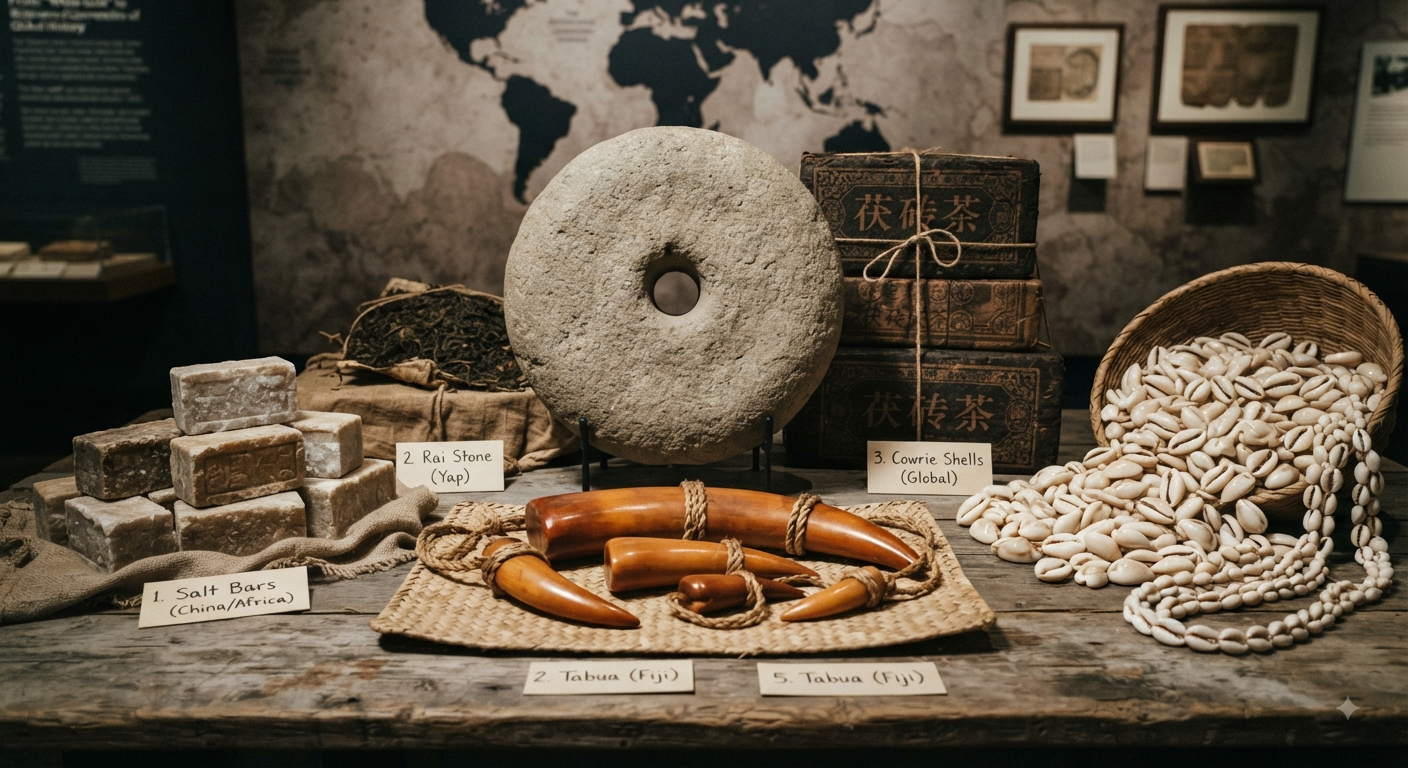
Before the establishment of paper banknotes, metal coins, and digital transactions, the concept of money was far more tangible, vivid, and, often, bizarre. The value of a currency was not backed by government guarantees, but by its practical utility, scarcity, and cultural significance. Here is a look back at five of the most unusual objects humans have used as an official medium of exchange. For more articles like this, please read, Five Peculiar Savings Accounts of The Economic Crisis.
1. Salt: The "White Gold" of Antiquit
Salt was one of the most powerful currencies of the ancient world, as it was essential for food preservation. In Ancient Rome, soldiers were sometimes paid directly in salt or received a special allowance to purchase it, known as salarium (from the Latin word sal), which is the root of the word "salary" in many European languages. In imperial China, salt was a state monopoly and was compressed into officially stamped bricks, while in medieval Africa, amole salt bars were used to buy goods and pay taxes.
2. Rai Stones: The Immovable Money of Yap Islands
On the opposite end of portable currencies, the inhabitants of Yap Island in Micronesia created one of the heaviest transaction systems ever. "Rai Stones" were giant, circular limestone discs with a hole in the middle, with diameters reaching up to four meters. Due to their immense weight, the stones were never moved during transactions. They remained in the exact same spot, and their ownership changed simply through an oral agreement before the community. The most fascinating part? Even if a stone was lost to the ocean floor during transit, it retained its value, as everyone agreed it was simply resting down there.
3. Cowrie Shells: The Longest-Lasting Global Currency
If you are looking for the most successful natural currency in history, look no further than the Cowrie shell (Monetaria moneta). From 1200 BC until the 19th century, these small, glossy shells dominated the markets of China, India, Africa, and Oceania. They were durable, impossible to counterfeit, uniform in size, and their shape allowed merchants to string them together for easy counting. Their use was so widespread that it influenced the economic balance of entire continents for centuries.
4. Tea Bricks: Money You Can... Drink
In the nomadic regions of China, Mongolia, Tibet, and Siberia, metals were scarce, but tea was precious. Therefore, from the 9th century until World War II, tea leaves were compressed into hard, compact bricks with embossed stamps, functioning as currency. Their value was determined by the quality of the tea and the geographical distance from the production source. The unique advantage of this currency was its ultimate utility: in times of crisis, famine, or illness, residents could literally consume their money as food or medicine.
5. Tabua: The Sacred Whale Teeth of Fiji
In the Fiji islands, the economy was closely linked to spirituality through Tabua – the teeth of the sperm whale. These teeth were cleaned, polished with coconut oil, and smoked until they took on a deep orange-brown hue. Tabua were not used for everyday, minor purchases, but held immense diplomatic and social value. They were the ultimate gift for sealing peace between tribes, formalizing marriages, or settling serious crimes. To this day, they remain precious family heirlooms, and exporting them from the country is strictly forbidden without a government permit.
Note(please read it): This is not financial advice and it is for educational purposes only. Any decision you make for your financial life is due to your own intelligence after your own research.
Related Articles
- The journey of wealth building never stops, just like the relentless work of the ants and bees. With the turning of the page to August 2026, our hypothetical 1,000 budget is put back to work with renewed discipline. To see how we apply the core pillars of saving, debt management, and fixed expenses this month, continue reading the full breakdown in Wealth Building: Ants, Bees, and the Monthly Paycheck.
- If you enjoy this article you can help us by leaving a review, if you really enjoy our financial tips, you could head over to my Page and dive into the e-magazine Ants and Bees, where we explore the history and evolution of money through the centuries—though rest assured, it is strictly a historical and educational journey, not a financial advice magazine! 85% down in any issue, just by using the coupon: 9V585JSQP7
Thank you very much. From Syrinx and Spear.