
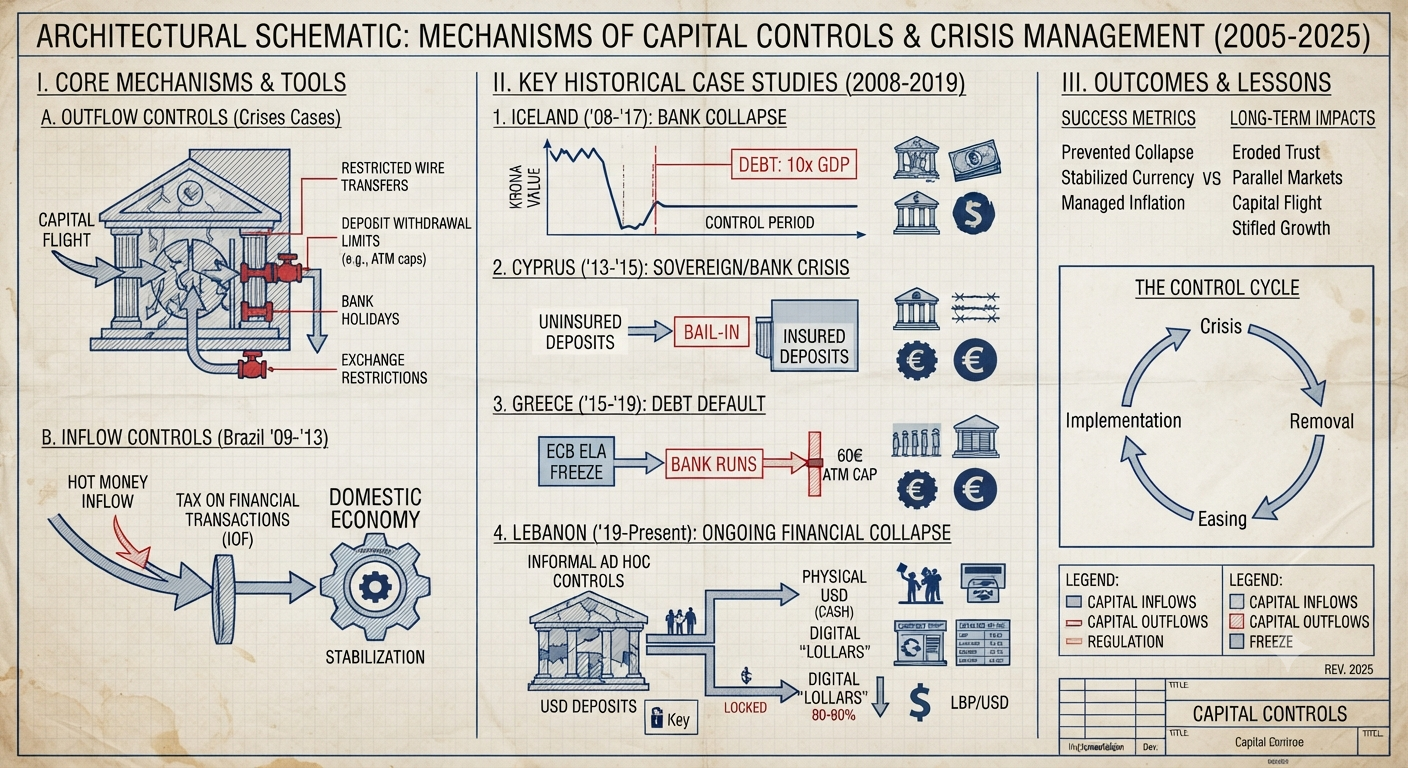
Here are four of the most famous and impactful capital control cases from the last two decades:
Iceland (2008–2017)
- The Crisis: During the 2008 global financial crisis, Iceland's three mega-banks (Glitnir, Landsbanki, and Kaupthing) collapsed almost simultaneously, with debts nearly ten times the country's GDP.
- The Controls: The government froze foreign exchange transactions, banned foreign investors from pulling money out of domestic assets, and limited citizens from moving money abroad.
- The Outcome: The controls prevented total economic collapse and were fully phased out and lifted by 2017.
Brazil (2009–2013)
- The Crisis: Unlike cases stopping outflows, Brazil faced a massive wave of capital inflows after the 2008 crisis as U.S. monetary easing flooded emerging markets with "hot money," heavily appreciating the real.
- The Controls: Brazil introduced the IOF tax, applying levies ranging from 2% to 6% on foreign investments entering local fixed-income and bond markets to cool down currency appreciation.
- The Outcome: The tax offered temporary relief against currency overvaluation until global market dynamics shifted by 2013.
Cyprus (2013–2015)
- The Crisis: Heavily exposed to Greek sovereign debt and a bloated banking sector, Cyprus faced insolvency and had to secure an international bailout featuring a painful "bail-in" on uninsured depositors.
- The Controls: As a Eurozone member, Cyprus implemented emergency controls—shutting banks for nearly two weeks, capping daily ATM withdrawals, and requiring central bank approval for electronic transfers abroad.
- The Outcome: The restrictions stopped a complete flight of euros from the island and were progressively lifted by April 2015.
Greece (2015–2019)
- The Crisis: At the height of the Greek debt crisis in mid-2015, a looming default and a massive bank run triggered a freeze on emergency liquidity from the European Central Bank.
- The Controls: Greece declared a bank holiday, closed commercial banks for weeks, restricted daily ATM withdrawals to €60, and placed strict oversight on cross-border wire transfers.
- The Outcome: The measures kept the crippled financial system afloat during bailout negotiations before being fully removed in September 2019.
Lebanon (2019–Present)
- The Crisis: Following the onset of a severe economic and financial collapse in October 2019, Lebanon faced a total loss of confidence in its banking system.
- The Controls: Unlike formal legislative emergency laws, commercial banks implemented informal, ad hoc controls unilaterally. They blocked depositors from accessing foreign currency (U.S. dollar) accounts, barred international wire transfers, and created a parallel system where digital "lollars" trade at a massive discount to physical cash.
- The Outcome: While intended to stop a total bank run, the restrictions severely crippled business operations, eroded public trust, and forced a heavy reliance on a cash-based, dollarized economy.
For this and similar stories like this, do not forget the e-magazine Ants & Bees is here, make it yours with just a click: Ants & Bees: Issue 1