
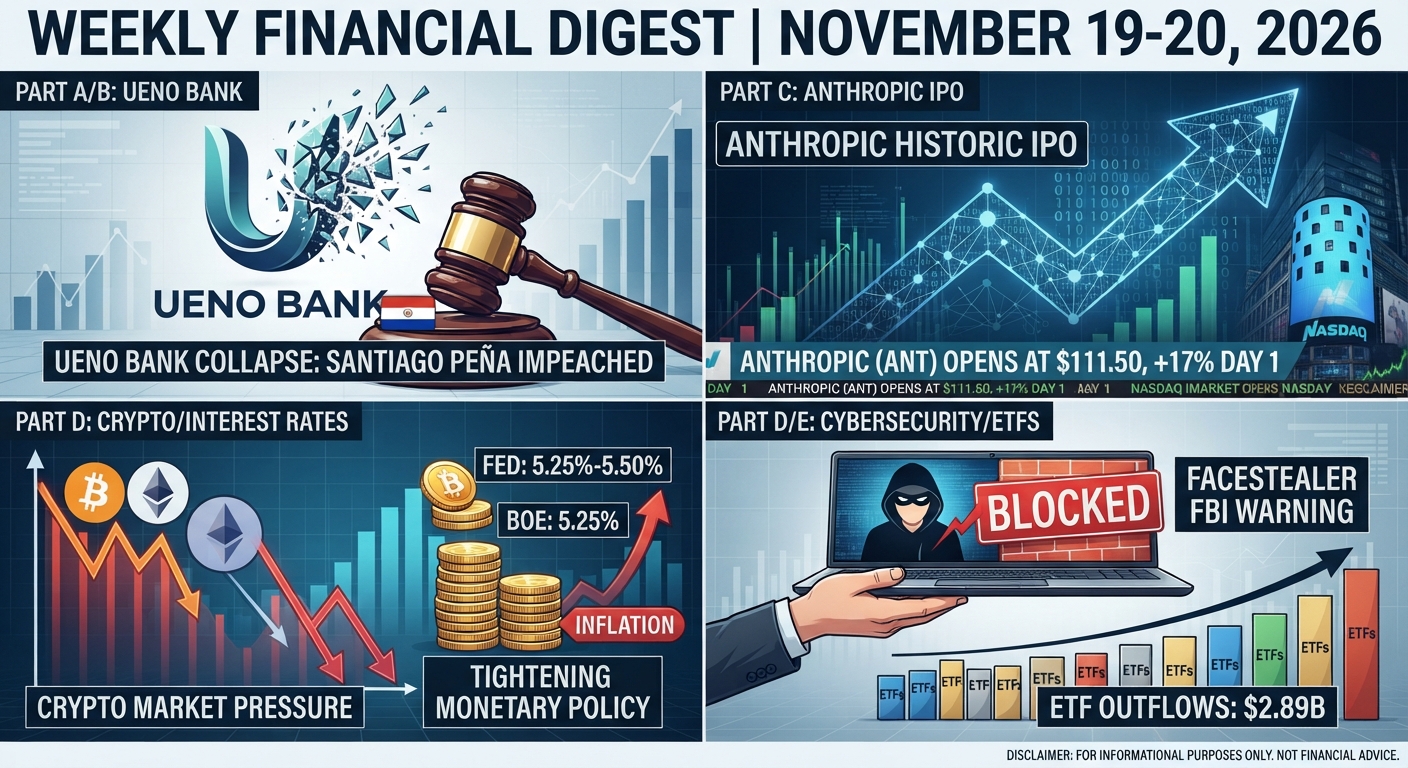
(Economic Monitor November 2026: Eurozone inflation hits 4%, Paraguay bank collapse ousts a president, Binance $6.3B hack update, Anthropic’s record IPO, and crypto pressures.)
Part A — Inflation: The Global Picture & Extremes
📊 Eurozone & European Union Annual inflation in the Eurozone rose to 4.0% in October 2026, up from 3.8% in September. Across the European Union as a whole, it also stood at 4.0%, compared to 3.8% the previous month. The primary driver of the increase was energy, contributing +1.89 percentage points, followed by services (+1.55 pp). Global average inflation is projected at 4.7% for 2026, according to the IMF.
The 5 Countries with the Lowest Inflation
Rank Country Inflation Notes
1🇸🇪 Sweden 0.6% Lowest rate in Europe
2🇨🇭 Switzerland 0.7% Traditional haven of stability
3🇨🇳 China 1.0% Complex conditions, near deflationary trends
4🇲🇦 Morocco 0.9% Relative price stability
5🇨🇿 Czechia / 🇩🇰 Denmark 2.1% Tied in the European ranking
🔴 The 5 Countries with the Highest Inflation
Rank Country Inflation Notes
1🇻🇪 Venezuela 467.9% Hyperinflation, deep economic crisis
2🇮🇷 Iran 78.6% Sanctions and geopolitical tensions
3🇸🇩 Sudan 41.3% Conflict and infrastructure collapse
4🇦🇷 Argentina 32.5% Currency instability
5🇹🇷 Turkey 31.2% Monetary policy and lira depreciation
Part B — 🏛️ Economic Latest Events
The Ueno Bank Scandal: When a Bank Collapse Ousted a President
What happened? On November 3, 2026, the Central Bank of Paraguay revoked the operating license of Ueno Bank, the country's largest digital bank, and placed it into resolution due to insolvency. Inspectors found that between 2025 and 2026, Ueno had issued $140–150 million in illegal loans to companies linked to its parent conglomerate, Grupo Vázquez. Its actual solvency ratio was revealed to be 5.56%—less than half of the 12% legal minimum.
The Impact
- 2.9 million customers—roughly 63% of Paraguay's adult population—found their accounts frozen
- $850 million in public funds and social security reserves had been deposited in the bank, $380 million of which belonged to pension funds
- Approximately 97% of individual accounts are covered by the deposit guarantee fund, yet only 30–35% of the total value of deposits is insured
- Thousands of people took to the streets in Asunción and other cities, sparking strikes and protests that lasted for days
Political Fallout President Santiago Peña—who held shares worth approximately $1 million in the parent company until April 2025—initially offered to resign. However, Congress rejected his resignation so he could not evade justice through the lifetime senatorial immunity granted by the Constitution to former presidents. On November 6, 2026, the Senate unanimously impeached and removed him from office by a 44–0 vote, stripping him of his immunity, and Vice President Pedro Alliana assumed the presidency until 2028. Peña was placed under arrest on charges of "breach of trust and self-dealing," while the Governor of the Central Bank, a former Ueno executive, was also arrested for falsifying regulatory filings. Arrest warrants have been issued for 27 executives of the group.
Binance Hacking: News
Following the record $6.34 billion Binance hack on October 29, 2026, major legal and on-chain developments have unfolded over the past two days. On November 19 and 20, attackers moved nearly $600 million in Ether (ETH) into newly created wallets, routing funds through cross-chain swap protocols like THORChain and Chainflip. According to blockchain intelligence firm Elliptic, the hackers have used automated scripts to move stolen funds across thousands of wallets and multiple blockchains, swapping portions into Bitcoin and using coinjoin mixers to obscure the trail.
In response, Binance secured a landmark $6.5 billion worldwide freezing injunction on November 19 from the Abu Dhabi Global Market (ADGM) Courts. As reported by City A.M., the order breaks new legal ground by allowing Binance to serve the injunction directly via the blockchain across a "living list" of roughly 26,000 wallet addresses holding stolen assets. So far, around $2.85 billion of the stolen crypto has been frozen or intercepted by third parties and issuers—with U.S. prosecutors also winning court authorization to seize or restrain over $1.2 billion of those frozen funds.
The FBI formally attributed the heist to North Korea's state-sponsored hacking group TraderTraitor (also known as the Lazarus Group). Per Binance's incident update, attackers compromised internal infrastructure—including a DevOps engineer's laptop and Ethereum EIP-7702 authorizations—to drain hot wallets across multiple blockchains. Binance temporarily paused withdrawals before resuming operations on November 1, and the exchange has replenished user balances using its corporate treasury, SAFU fund, and insurance reserves.
UK Interest Rate has Been Increased
On November 5, 2026, the Bank of England implemented its first interest rate hike in over three years, raising the base rate by 0.25% to 4%. This decision was deemed necessary as the prolonged crisis in the Middle East drove fuel and energy prices sharply higher once again, pushing inflation to 3.6%, with projections that it could even reach 5% by mid-2027. Through this tightening, the central bank is attempting to curb the broader wave of price increases and wage pressures across the economy, leaving the door open for further interventions to bring inflation back to its 2% target.
At the same time, the UK government announced in its Autumn Budget an extraordinary, temporary increase to the bank corporation tax surcharge, doubling it from 3% to 6% for 15 months—from January 1, 2027, to March 31, 2028—on profits exceeding £100 million. This measure is expected to generate approximately £1.5 billion for the public coffers, which will be directed toward funding a household support package to offset rising energy costs. In doing so, London is tapping into the expanded profit margins banks are reaping from the higher interest rate environment to provide relief to citizens without placing an additional burden on the state budget.
Part C — 🚀 Anthropic's Historic IPO: Why Is Everyone Talking About It?
What is Anthropic? Anthropic is an artificial intelligence company founded in 2021 by former OpenAI executives, including siblings Dario and Daniela Amodei. It is the creator of Claude, one of the most powerful general artificial intelligence models in the world, known for its safety, accuracy, and ability to process very large text files. In less than five years, it transformed from a startup into a company that went public with a historic offering.
The Numbers — Records That Surpassed Every Precedent
- $81.3 billion: The amount raised from the initial public offering—the largest IPO in history, surpassing that of SpaceX ($75 billion)
- Offer price: $83 per share. Opened trading at $111.50, closing its first day at $97.17—a 17% gain in a single session
- Valuation: Approximately $1.5–2 trillion, making it one of the most valuable technology companies in the world
- Revenue: $33.24 billion in just nine months (a 1,200% increase year-over-year)
- Voting rights: The seven co-founders hold 50.1% of the voting rights through a special structure, ensuring full control over the company's direction
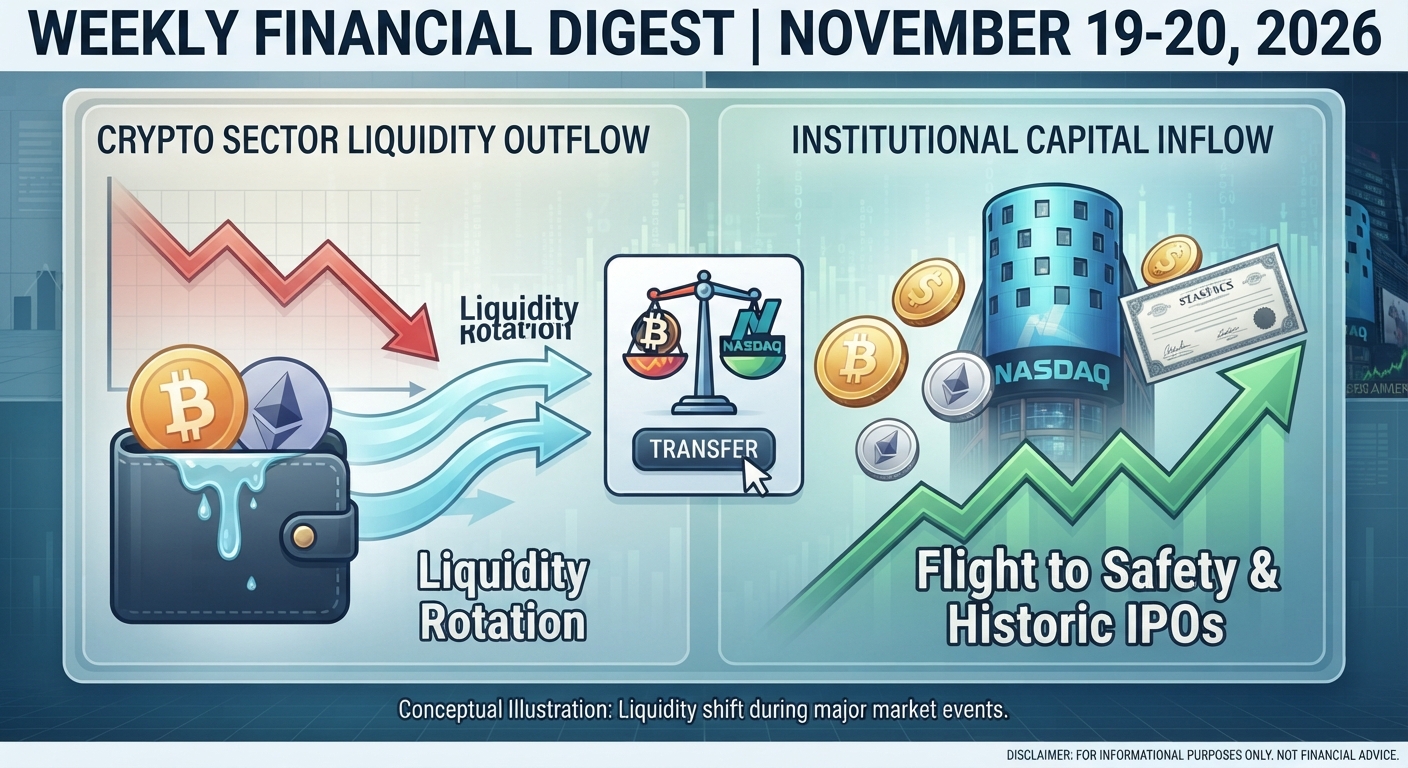
Why Is Capital Moving? This is perhaps the most important question of the day. As Brad Garlinghouse, CEO of Ripple, pointed out, investors are temporarily shifting liquidity out of cryptocurrencies into historic offerings like Anthropic's—just as happened with the SpaceX IPO in June. There are three reasons for this:
- Safety & Institutional Acceptance: A regulated and supervised stock on the Nasdaq is easier for large portfolios to justify from a risk perspective than cryptocurrencies
- A Historic Offering: When an opportunity emerges that the entire market watches as a milestone event, liquidity temporarily rotates in to participate
- Cyclicality: Just as occurred after the SpaceX IPO, the expectation is that once this phase concludes, capital will rotate back into other asset classes
Part D — 📉 Cryptocurrencies: Pressures, Interest Rates, and Outlook
The Current Picture
- Bitcoin: Hovering near $61,600, having lost roughly 13% in a week and testing the $60,000 psychological threshold
- Ethereum: Trading at $1,745, with losses of roughly 13% over the past week
- ETF Outflows: U.S. Bitcoin ETFs have recorded $2.89 billion in net outflows in November alone, with BlackRock's product (IBIT) accounting for 83% of those withdrawals
🏦 Interest Rates — The Deeper Cause of the Pressure
🇺🇸 United States The U.S. Federal Reserve (Fed) held interest rates steady at 5.25%–5.50% at its latest meeting. The meeting minutes reinforced expectations that rates will remain higher for longer—and could even rise if inflation does not cool at a steady pace. When interest rates are high, the "opportunity cost" of holding non-yielding assets like cryptocurrencies increases: investors favor safe returns from government bonds rather than taking on risk.
🇬🇧 United Kingdom The Bank of England held its base rate steady at 5.25%. Inflation in the UK remains above the 2% target, making any discussion of rate cuts premature. As in the U.S., the high-interest-rate environment acts as a headwind for risk markets.
What does this mean for you? As long as interest rates remain elevated, liquidity in risk markets—including cryptocurrencies—will stay tight. When rate cuts begin, that will be the signal for liquidity to return. Until then, patience is the most valuable asset.
🔒 Cybersecurity: A Warning for Everyone The FBI announced the dismantling of a network of North Korean hackers using a method known as FaceStealer: they set up fake meetings via video conferencing platforms, recorded the participants, and subsequently used the footage to deceive colleagues and security systems. Using this method, they had stolen over $400 million over the past 18 months, specifically targeting companies and investors in the cryptocurrency space. The takeaway is simple: never verify identity via video alone—always use two-factor authentication or a security passphrase.
📚 Sources & References
- European Statistical Office (Eurostat) — October 2026 Inflation: https://ec.europa.eu/eurostat/web/products-euro-indicators/w/2-18112026-ap
- Visual Capitalist — Global Inflation 2026: https://www.visualcapitalist.com/mapped-inflation-rates-around-the-world-in-2026/
- Wikipedia — 2026 Paraguayan Banking Crisis: https://en.wikipedia.org/wiki/2026_Paraguay_banking_crisis
- The Conversation — The Collapse of Ueno: https://theconversation.com/paraguays-bank-collapse-brought-down-a-president-and-exposed-as-myth-the-nations-status-as-a-dubai-of-south-america-296112
- The Guardian — Ueno Bank and Peña's Impeachment: https://www.theguardian.com/world/2026/nov/07/paraguay-ueno-bank-collapse-santiago-pena
- CNBC — Anthropic IPO: https://www.cnbc.com/2026/11/19/anthropic-ipo-ant-live-updates.html
- BBC — Anthropic IPO: https://www.bbc.co.uk/news/live/c933xxm82mr8t
- CryptoNews — Bitcoin ETF Outflows: https://crypto.news/bitcoin-etf-november-outflows-bitfinex-cost-basis/
- CryptoNews — Garlinghouse on Liquidity and IPO: https://cryptonews.com/news/garlinghouse-xrp-price-anthropic-ipo/
- The Globe and Mail — Cryptocurrency Market: https://www.theglobeandmail.com/investing/markets/markets-news/motley/8926747/crypto-market-today-nov-19-bitcoin-approaches-60-000-as-etf-outflows-surpass-2-5-billion-in-2026/
- FBI — FaceStealer: https://www.fbi.gov/investigate/cyber/facestealer-cryptocurrency-theft-scheme
Disclaimer: This article compiles publicly available information as of November 19–20, 2026, for informational purposes only. It does not constitute financial or investment advice; always do your own research. Sources are linked above for verification.
Other Articles of the Blog Syrinx and Spear about The History of Money and Market.
Four Times the Money Became Wortless.
From the First Central Banks to the Modern Banking System.
Five Peculiar Saving Accounts of Economic Crisis.
Five Unsual Currencies of Global History
Five Bizarre Currencies of Global History