
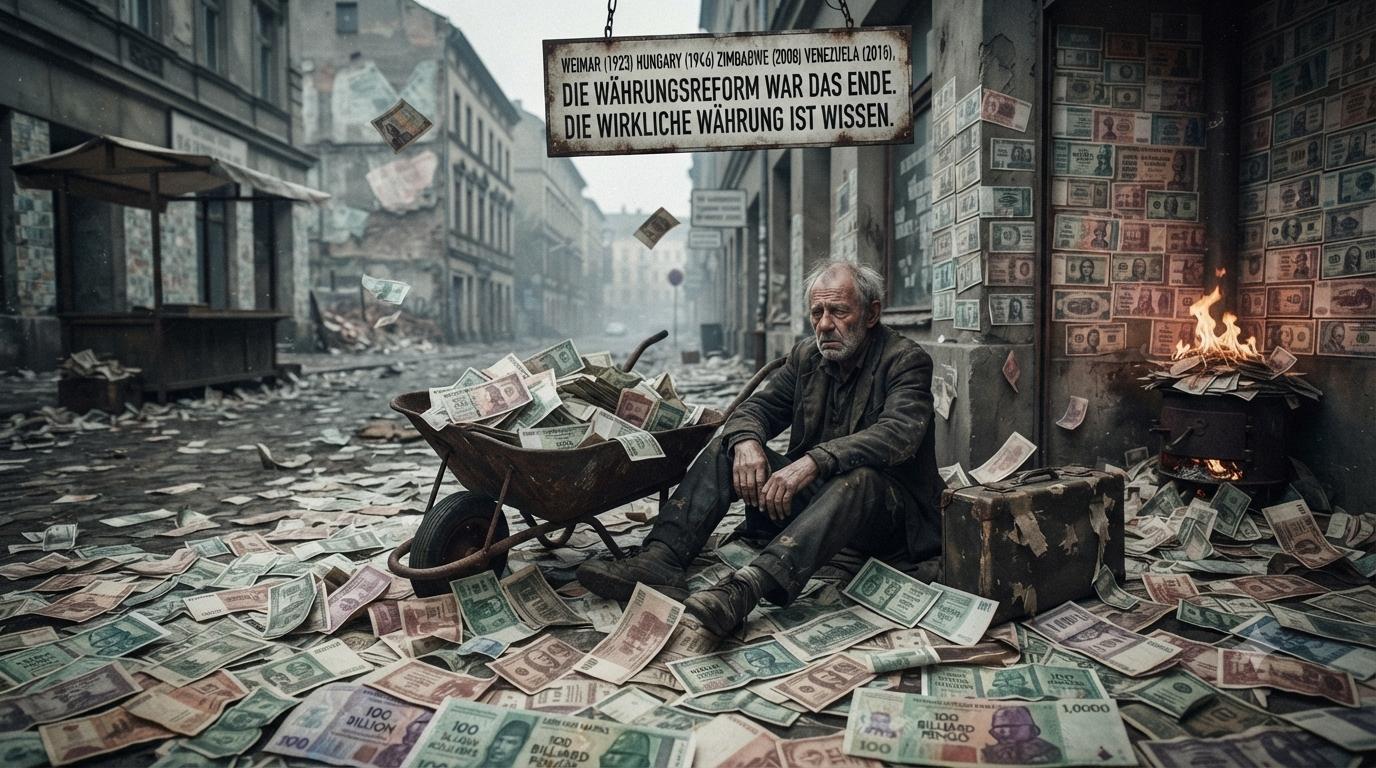
In this post, we examine four historical moments when money completely lost its value and ended up as mere pieces of useless paper. A harsh reminder that wealth is fragile and that knowledge is the only real tool to protect what you have built.
The Weimar Republic (Germany, 1923)
Germany had to pay massive war reparations after World War I. To meet this need, the government began printing marks uncontrollably to buy foreign currency and pay striking workers. Due to hyperinflation, the value of the mark collapsed so rapidly that workers were paid twice a day. Restaurant prices changed during the course of a meal. People transported cash in wheelbarrows, while banknotes ended up being used as wallpaper or kindling for stoves, as their heating value was greater than their purchasing power.
Hungary (1946)
The country was completely destroyed economically and infrastructurally after World War II. To cover expenses, the government began printing the currency "Pengő" in astronomical quantities. This is the worst hyperinflation ever recorded in history. Prices doubled every 15 hours. On August 1, 1946, the government withdrew the pengő and introduced the forint. The replacement rate was 400 octillion pengő for just 1 forint, wiping out the savings of all citizens within hours. The streets of Budapest were filled with discarded banknotes that no one even bothered to pick up.
Zimbabwe (2008)
Robert Mugabe's disastrous agricultural reform led to a collapse of production and the economy. The central bank began printing Zimbabwean dollars to fund the military and government deficits. Inflation reached 89.7 septillion percent per month. The infamous 100 trillion dollar banknote was issued, which was not even enough to buy a bus ticket or a loaf of bread the next day. People lost their pensions and the labors of a lifetime, as the money in the banks became worthless. The government was forced to completely abolish the national currency.
Venezuela (2018)
The drop in oil prices and the mismanagement of the socialist government sent the economy into a free fall. Nicolás Maduro's government continuously printed the "Bolívar" to cover state expenses, while imposing strict price controls. Money lost its value so rapidly that shops stopped counting banknotes and started weighing them instead. In August 2018, the government decreed the removal of five zeros from the currency, turning citizens' cash into useless pieces of paper overnight. Citizens turned to bartering or foreign currency to survive, as the Bolívar no longer held any purchasing power whatsoever.
Related Article: The Collapse of Ueno Bank
For this and similar stories like this, do not forget the e-magazine Ants & Bees is here, make it yours with just a click: Ants & Bees: Issue 1. 85% down in any issue, just by using the coupon: 9V585JSQP7