
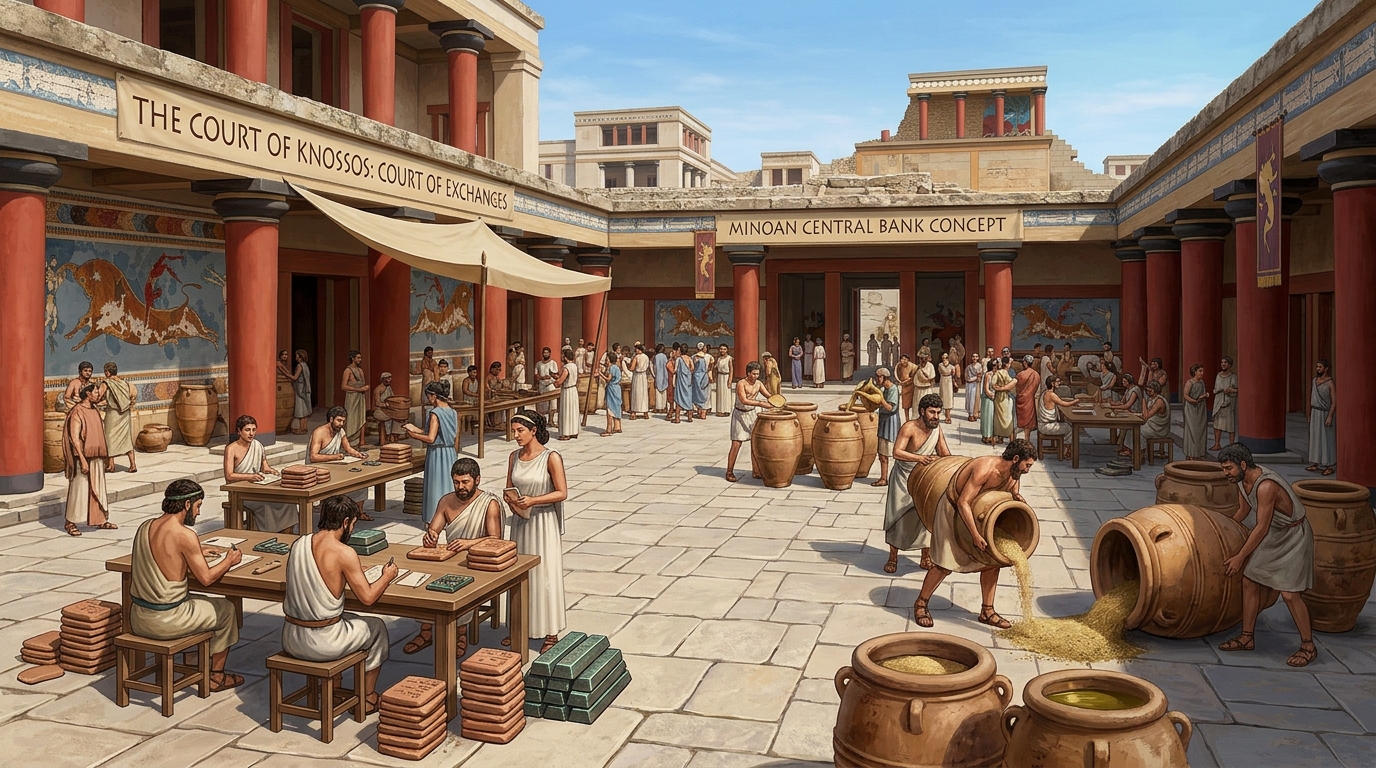
(Knossos courts were not just for bull-leaping and rituals. Their size, paving and links to storage show they served as daily hubs for barter, trade and redistribution in the Minoan economy.)
Walk into any guidebook, museum plaque, or standard article about Knossos, and you will read the same thing: the Central Court was where bull-leaping and religious processions took place. The West Court, they say, was an approach for ceremonies and sacred gatherings. Rarely does the text acknowledge the obvious: a space that large, so centrally placed, so directly connected to storage, workshops, and the surrounding town — could it have sat empty 350 days a year, waiting only for festival days? That is the question too often skipped over.
The prevailing view owes much to Sir Arthur Evans. When he excavated the palace from 1900 onward, he saw a temple-kingdom: a society ruled by priest-kings, where architecture existed first for ritual display. He shaped the site and its interpretation to match that vision. For over a century, that framework has coloured how every court, corridor, and pit is described. But if we look past the ritual-first default, the architecture itself tells a different story: these were spaces of daily meeting, transaction, and distribution — where the barter system that sustained the palace economy met the people who lived outside its walls.
The West Court: Paved and Positioned for Trade
The West Court is the first thing a visitor encounters. It is a broad, open expanse — roughly 6,500 square metres — paved in limestone, sitting directly between the palace’s monumental west façade and the denser housing of the lower town. Three raised causeways run across it, leading straight toward the main gateways. Beneath its paving lie three deep circular pits — the kouloures — originally dug as storage silos before being filled in and the court levelled over them.
What matters here is not what happened during festivals, but what happened on an ordinary Tuesday:
- Visibility and access: The court was the palace’s public face. Farmers, artisans, and sea traders would not have been invited deep into the labyrinthine storage wings to negotiate. They met here, in the open, where authority could be seen and goods could be displayed without crossing the palace threshold.
- Flow of goods: The causeways were not ceremonial paths — they were heavy-traffic routes. From the court, people moved directly into corridors that led to the magazines holding the palace’s main wealth: olive oil, wine, grain, wool, bronze, and finished craft goods. Agreements made in the court were fulfilled through those very doors.
- Scale and function: This was not a small forecourt. It could comfortably accommodate hundreds of people, stalls, and piled goods. There is no practical reason to pave and maintain such a space if it stood idle most of the year.
Scholarship acknowledges the market possibility as an afterthought — "possibly markets alongside rituals" — but the balance is wrong. The layout suggests exchange was the primary function, with ceremony layered on top.
The Central Court: Distribution at the Heart
At the very centre of the palace lies the great rectangular paved area — 52 metres north-to-south by 28 metres east-to-west — aligned precisely to the cardinal axis. Every major wing opens onto it. The west wing, immediately accessible, contains the magazines with rows of giant pithoi storage jars, administrative rooms, and shrine spaces side by side. The north entrance leads toward the harbour; the south propylaea toward the inland Messara plain; the east staircase down to workshops and residential quarters.
In the ritual-only reading, this is where bull-leaping spectacles and royal processions unfolded. Those things may well have happened — on specific days. But for the rest of the year, this was the palace’s main thoroughfare and distribution floor:
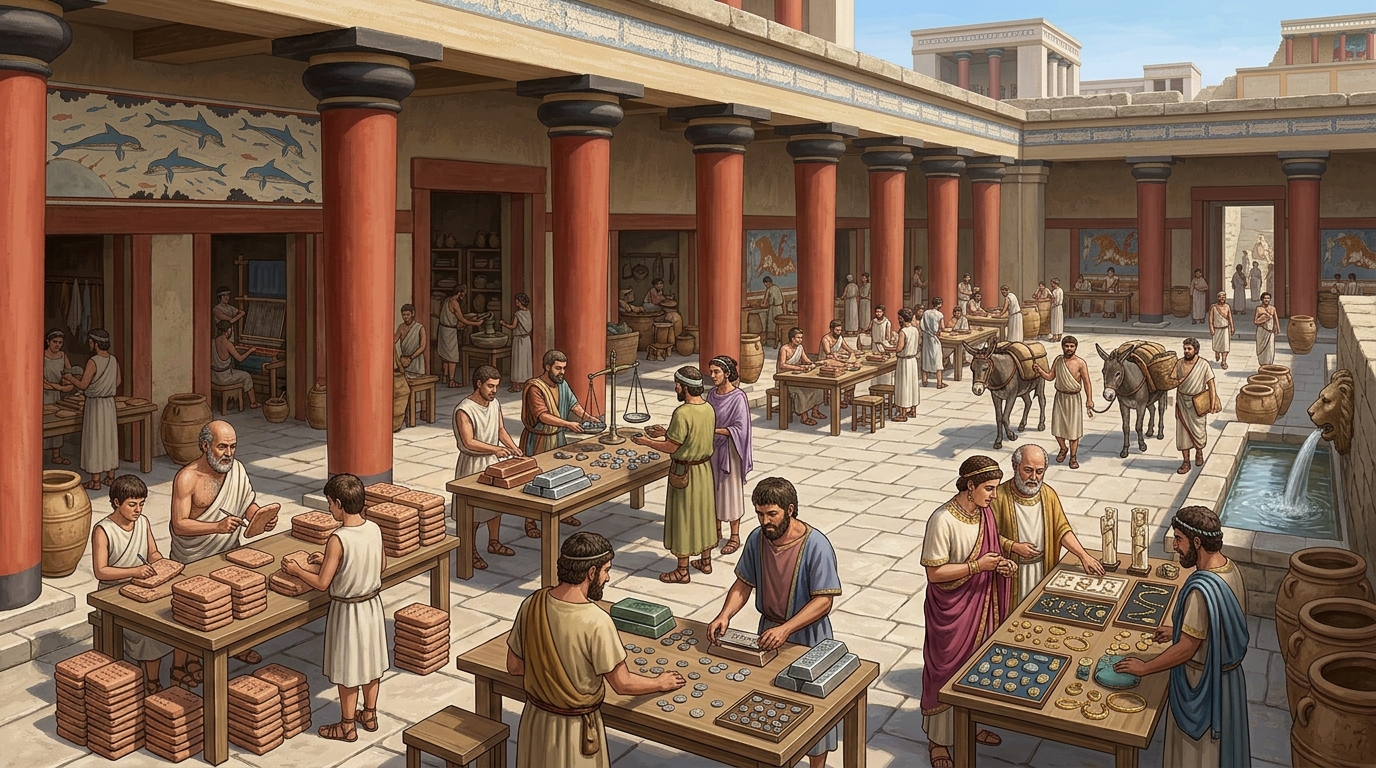
- The barter interface: The Minoan economy operated not with coined money, but through redistributive barter — produce and raw materials flowed in, stored value flowed back out, often as finished goods or rations. The Central Court was where this system became visible. A shepherd bringing wool, a potter taking surplus clay, a ship’s captain arranging olive oil for export — they would gather here, where officials could meet them directly, track transactions through sealings and Linear A records, and authorise release from the magazines.
- Proximity to wealth: The storage magazines begin just a few steps from the court’s western edge. Goods did not need to be carried far to be shown, weighed, or handed over. The court was the showroom and the meeting hall combined.
- Two-way movement: Unlike later temple courtyards designed for controlled, one-way processions, the Central Court offered multiple entry and exit points. It was built for constant cross-traffic, not for watching a single focal event.
Ceremony may have used the space, but the architecture serves circulation, not just performance.
How the Daily Economy Worked Here
The system was not a free market in the modern sense — the palace held and managed the bulk of stored wealth. But it relied on constant negotiation with those who produced it:
- Inward: Farmers brought grain, olive oil, wine, honey, wool. Herders brought livestock. Artisans brought finished pottery, textiles, metalwork. Merchants brought copper from the Aegean, ivory from Egypt, tin from the west.
- The meeting: These exchanges were negotiated in the open courts — West Court for general dealings with the town, Central Court for transactions directly involving palace stores and export shipments. Agreements were sealed with clay tokens, recorded in Linear A, and goods were released.
- Outward: The palace redistributed — as rations, as raw materials for craft workshops, as trade cargo sent across the Mediterranean. The courts were where that redistribution was seen to happen, openly, reinforcing trust in the system.
This is the missing piece: authority was maintained not just by hidden tablets, but by visible exchange. When people saw goods moving through the courts, they saw the system working. That visibility was as important as the storage itself.
The Overlap: Festivals and Everyday Use
None of this denies that major ceremonies took place. Bull-leaping, public feasting, seasonal gatherings — these are attested in finds and iconography. But the mistake is treating those events as the only purpose. A village church holds weekly services, but it also hosts markets, meetings, and community gatherings. So too the courts:
- Festivals drew crowds from across the region — the West Court’s scale suited exactly that.
- On ordinary days, the same paving stones held baskets, scales, and conversation.
- The kouloures were first silos, then public space — economic function from the beginning.
The evidence does not force an either/or. It points to both: the same space adapted to daily commerce and periodic celebration. The error lies in dismissing the daily function as secondary or incidental.
Why This Matters
Reconsidering the courts changes how we see Knossos. It was not a priestly domain separate from the lives of the people, but a working marketplace integrated into the heart of the community. The palace’s power came not from mystery, but from management — from being the most reliable, accessible hub of exchange in the island.
The courts were not empty spaces waiting for the gods. They were where the economy breathed: where grain changed hands, where cargo was agreed, where surplus was turned into trade. The rituals were the high days. The barter was the daily life. And in the end, it was the daily exchange that built the civilisation.
Sources and perspectives: This article draws on the layout analysis of the site, storage-to-court proximity, discussions of Minoan redistributive economy and barter systems, and critical reassessments of Evans’s original interpretive framework by scholars including J. A. MacGillivray, Ilse Schoep, and contemporary Aegean prehistorians.
Related Article
The Concept of Value Exchange Through Centuries
Four Times the Money Became Worthless
Five Peculiar Savings Accounts of The Economic Crisis
Five Bizarre Currencies of Global History
A Welcome to my History Blog: For the Lovers of ancient Greek Mythology and Minoan History please feel free to visit our second blog hosted on Blogger: syrinxandspear.blogspot.com
- If you enjoy this article you can help us by leaving a review, if you really enjoy our financial tips, you could head over to my Page and dive into the e-magazine Ants and Bees, where we explore the history and evolution of money through the centuries—though rest assured, it is strictly a historical and educational journey, not a financial advice magazine! 80 % down in any issue, just by using the coupon: 9V585JSQP7
Thank you very much. From Syrinx and Spear.