
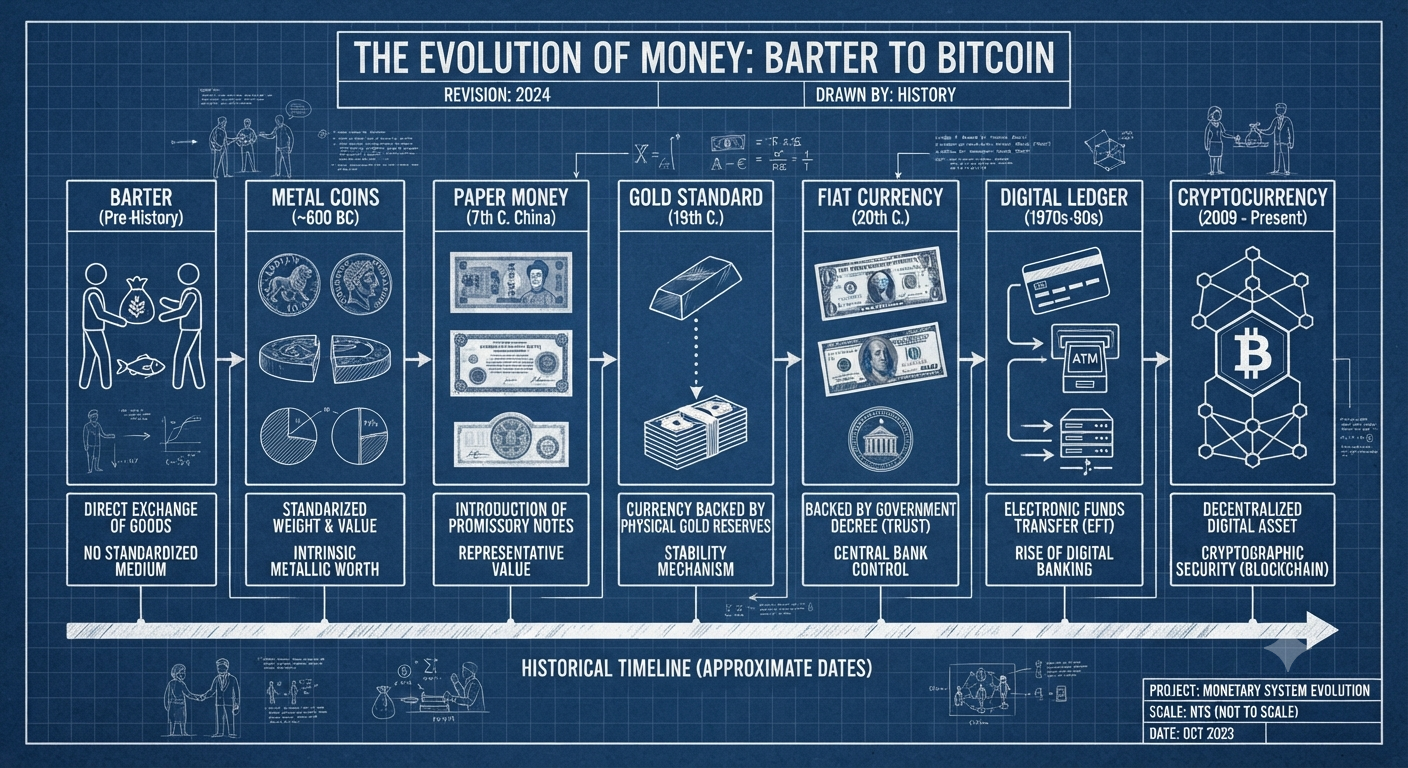
This blueprint provides a structural view of how value exchange has shifted over thousands of years. The timeline can be broken down into four distinct evolutionary phases:
1. The Era of Physical Exchange
- Barter (Pre-History): The earliest form of commerce relying on the direct swap of goods and services. It was limited by the "coincidence of wants," where both parties had to possess exactly what the other needed.
- Metal Coins (~600 BC): Introduced to provide a standardized, portable, and durable medium of exchange. These coins established the concept of intrinsic value based on precious metals like gold and silver.
2. The Era of Representation and Trust
- Paper Money (7th Century China): Developed as a convenient alternative to carrying heavy metal, evolving from promissory notes that held representative value.
- Gold Standard (19th Century): A system where the value of national currencies was strictly pegged to a country's physical gold reserves, providing international stability.
- Fiat Currency (20th Century): A major shift where money lost its physical backing by commodities and began to rely entirely on government decree and public trust.
3. The Digital Transition
- Digital Ledger (1970s–90s): The shift from physical cash to electronic data. This phase introduced banking infrastructure, credit cards, and Electronic Funds Transfers (EFT), allowing money to exist primarily as entries in a database.
4. The Decentralized Frontier
- Cryptocurrency (2009–Present): The current evolution toward decentralized digital assets. By utilizing blockchain technology, this phase removes the need for central bank control, replacing it with cryptographic security and a distributed public record.
For this and similar stories like this, do not forget the e-magazine Ants & Bees is here, make it yours with just a click: Ants & Bees: Issue 1