
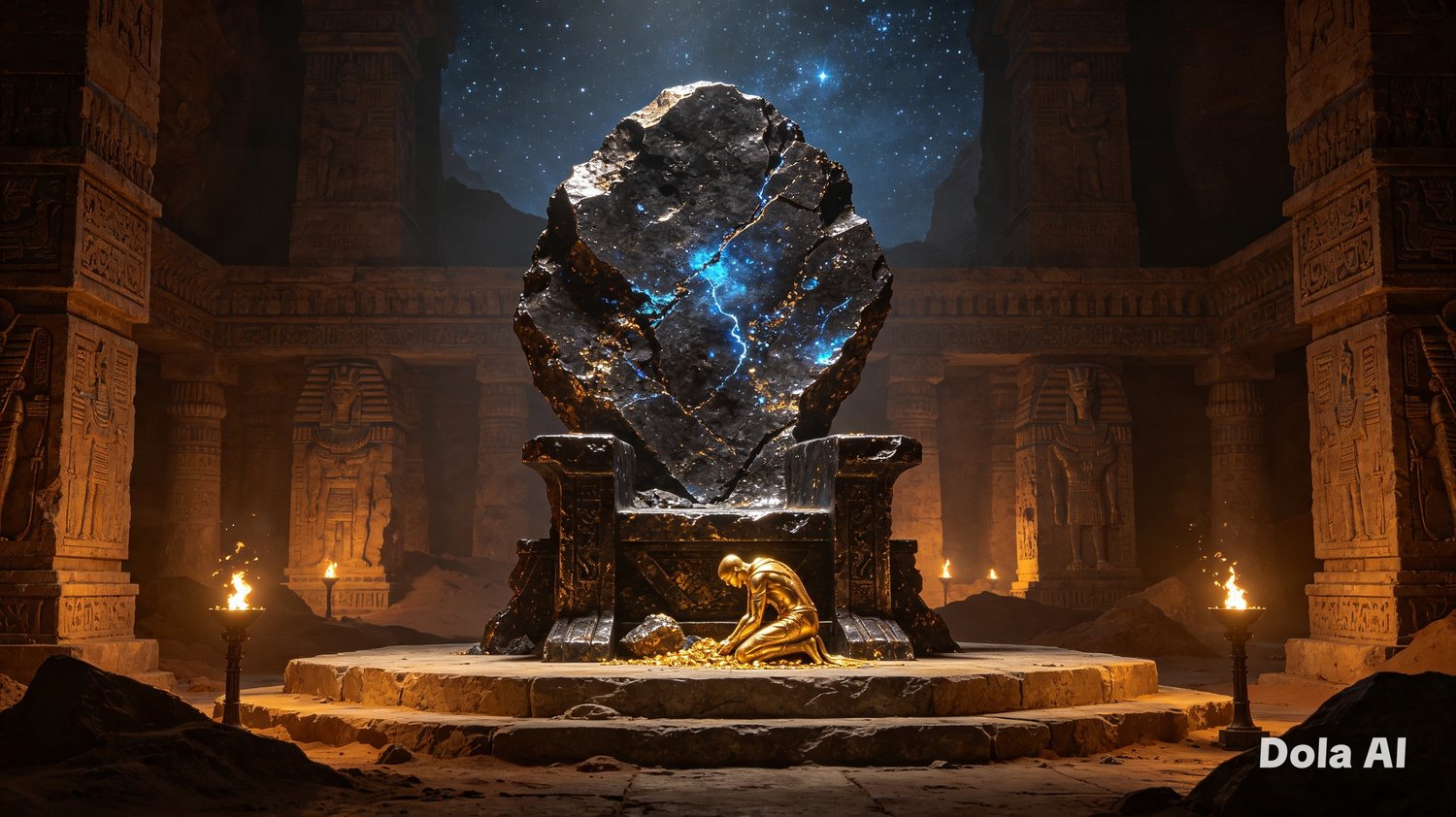
Thousands of years before iron became the backbone of industry and the cheapest common metal on Earth, it stood above gold as the most precious, sacred substance known to humanity. This was not myth or allegory; it was a hard reality of the ancient world, written into tombs, temples, trade records, and royal treasures across three continents. For over two thousand years, usable iron did not come from mines — it fell from the sky. People could dig gold from riverbeds and extract it from rock, but sky-iron appeared only when a meteorite struck the earth, arriving as a fragment of the heavens themselves.
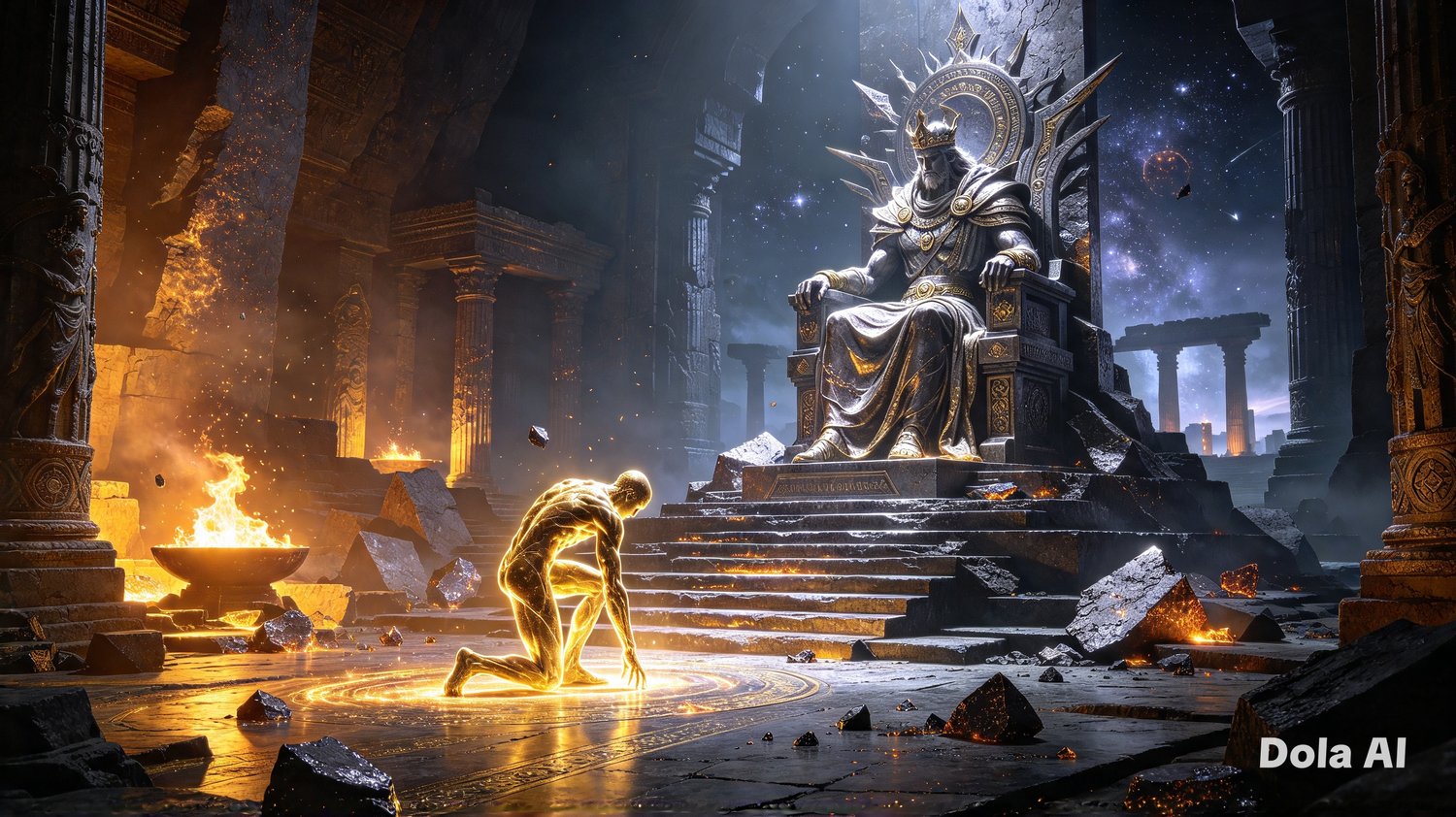
(Picture was created by Dola)
No one could make it, no one could manufacture it, and no one could predict where it would land. This made it rarer than any gem, more precious than the purest gold, and deeply sacred to every civilisation that touched it.
In ancient Egypt, this metal was called bia-en-pet, meaning “metal from the sky,” a name that reveals exactly how it was understood — a divine gift, not something of this world. The earliest known iron artefacts anywhere come from Egypt, dating back to roughly 3200 BCE, long before the pharaohs built the great pyramids. Beads strung together as precious jewellery were found in graves at Gerzeh, each one hammered from meteoric iron and placed alongside gold and ivory in burials of the elite.
When Tutankhamun was laid to rest around 1323 BCE, at the height of Egyptian wealth and power, his tomb overflowed with gold, but one object stood apart: a slender, perfectly forged dagger blade made entirely of meteoric iron. It rested close to his mummy, treated with the same reverence as his golden death mask, proof that even in an age of gold, sky-iron held a unique, unmatched status. Analysis later confirmed its origin beyond any doubt — it came from a meteorite that fell to earth, and it was prized enough to be buried with a god-king for eternity.
Across the Mediterranean on the island of Crete, the Minoans built Europe’s first great civilisation and shared this same awe for star-born iron. Long before anyone learned to smelt iron from ore, Minoan craftsmen worked meteoric iron with immense skill, often pairing it directly with gold as if the two metals were equals in value and holiness.
A striking example comes from the sacred site at Anemospilia, where a signet ring was discovered made from nickel-rich meteorite iron worn on the finger of a man believed to have been a high priest. This was not placed among ordinary offerings; it was kept in a sanctuary, reserved for someone who stood between the people and the divine, exactly where such a heavenly metal belonged. Minoan artisans also created pieces that combined gold and iron side by side — one half of a ring or ornament in gold, the other in sky-iron — treating them as twin sacred materials, one from the earth and one from the sky, equally precious and fit only for the highest ranks of society.
Though some of the most famous surviving iron rings have been found in Mycenaean tombs on the Greek mainland, they reflect Minoan influence and trade, showing that Crete was a key source and guardian of this precious metal across the Aegean world. In every case, these objects were buried alongside gold vessels, jewellery, and royal treasures, proving beyond argument that iron stood as an equal to gold in status and value.
Written records from the ancient Near East confirm just how extreme this difference in worth really was. Trade tablets from Assyria show that during the second millennium BCE, iron traded at eight times the value of gold and at times as much as forty times its weight in silver. Hittite kings guarded sources of meteoric iron as closely as they guarded gold mines, exchanging small pieces only as gifts between rulers and refusing to trade it in large quantities. In every treaty and letter that survives, iron is described as a “royal metal,” something to be given as a mark of highest honour rather than sold in the marketplace. No king would send a gift of common gold and expect it to be remembered as special, but a tiny blade of sky-iron was a gift worthy of an emperor.
Everything changed when humanity learned to smelt iron from ore, a breakthrough that took hold around 1300 BCE. For the first time, people could extract iron from common rock, and the supply that had once been limited to random meteor falls became endless. The value of iron did not merely fall; it collapsed. Within a few centuries, the metal that had rested beside pharaohs and priests in death became the material of ploughs, tools, and nails.
By the time the Roman Empire rose, iron was the cheapest widely used metal on earth, and the memory of its celestial origin faded into legend. Later moments would see iron valued highly in isolated places — such as in Tahiti in the 1700s, where nails were so scarce they bought entire boatloads of food — but these were moments of shortage, not of the ancient reverence for star-metal. In Prussia during the Napoleonic Wars, people wore iron jewellery as a patriotic symbol, but this was moral pride, not the metal itself being worth its weight in gold.
The story of iron and gold is a reminder that value is not fixed in the atoms of a metal; it lives in what people believe it is. For thousands of years, iron was the most precious thing on earth because it came from the sky, a piece of heaven that could be held in the hand. The Minoan priest wearing his iron ring, the Egyptian pharaoh taking his iron dagger into the afterlife, and the Assyrian scribe recording its worth at eight times that of gold — they all knew something we have forgotten: once, something that fell from above was worth more than anything dug from below.
Related Article
The Concept of Value Exchange Through Centuries
Four Times the Money Became Worthless
Five Peculiar Savings Accounts of The Economic Crisis
Five Bizarre Currencies of Global History
Note(please read it): This is not financial advice and it is for educational purposes only. Any decision you make for your financial life is due to your own intelligence after your own research.
A Welcome to my History Blog: For the Lovers of ancient Greek Mythology and Minoan History please feel free to visit our second blog hosted on Blogger: syrinxandspear.blogspot.com
- If you enjoy this article you can help us by leaving a review, if you really enjoy our financial tips, you could head over to my Page and dive into the e-magazine Ants and Bees, where we explore the history and evolution of money through the centuries—though rest assured, it is strictly a historical and educational journey, not a financial advice magazine! 80 % down in any issue, just by using the coupon: 9V585JSQP7
Thank you very much. From Syrinx and Spear.